
A deep article about the symbolism of feathers on your path: spiritual meanings, psychological interpretation, cultural imagery, and the meaning of a sign many people underestimate.
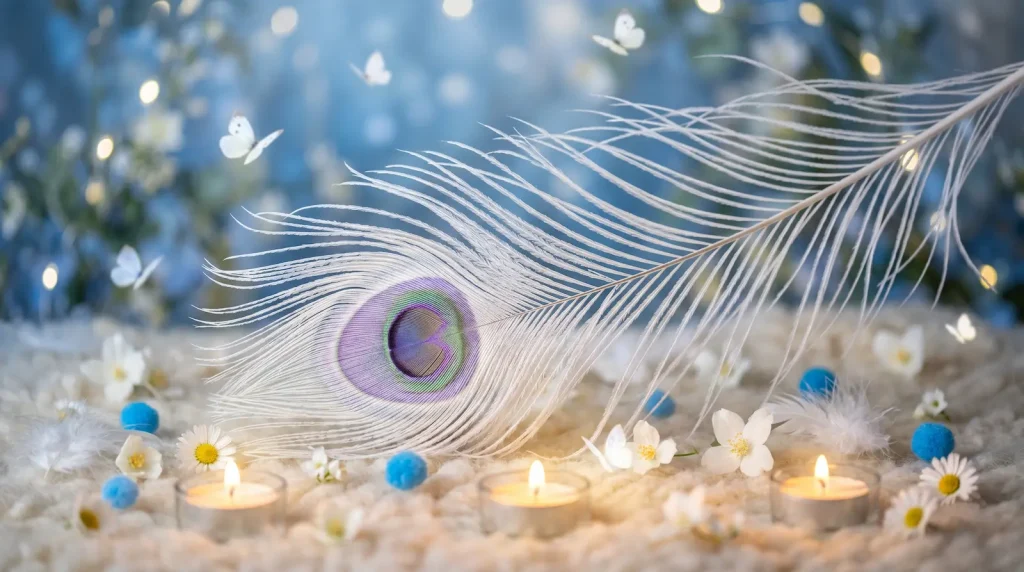
What Does It Mean to See Feathers on Your Path: Symbolism That Is Often Underestimated
A sign does not always arrive loudly. Sometimes it lies right under your feet — light, almost weightless, so ordinary that most people walk past it. Yet feathers often stay in memory not because of their shape, but because of a strange inner feeling: as if the moment was random, but not empty. In symbolic, cultural, and psychological interpretation, feathers are often linked not only with birds or nature, but with a message, direction, confirmation, or reminder a person notices especially clearly at the right moment.
A feather is not always about magic, but about attention to the moment 🪶
Many people treat feathers as a small detail until they begin noticing them at specific moments: after a painful conversation, before a major decision, in times of doubt, loss, or inner upheaval. And while such experiences should not be presented as proven supernatural facts, in symbolic culture they often function as a language of attention.
A person does not simply see an object. They give it meaning through their inner state. That is why a feather on the path can feel like a sign not because the world is literally sending messages, but because the psyche is sensitive to images that help gather meaning. There is nothing naive about that. On the contrary, it is one of the deeper forms of human thinking: we search for an image that helps us experience chaos not merely as chaos, but as something that may be trying to tell us something.
A feather is especially powerful as a symbol because it combines lightness and presence. It does not press, force, or demand. It seems to say: stop, look more carefully, not everything in this part of life is reduced to outer noise.
Why feathers are so often linked with support from above ✨
In many spiritual and folk traditions, feathers are associated with protection, connection between earth and sky, and the presence of invisible support. This does not mean every feather is automatically a “message from an angel.” Still, it is not accidental that this image has survived for centuries in religious, mystical, and cultural traditions.
Birds have always been creatures of the threshold: they belong to the earth, yet rise freely into the sky. A feather left behind seems to carry something of that liminal nature. It brings a trace of height down to the ground. That is why people often instinctively feel that a found feather is a gentle confirmation: you are not alone, your path is not as silent as it seems, there is something larger than your anxiety nearby.
This symbolism becomes especially strong when a person lacks inner support. After grief, during painful change, or in emotional exhaustion, even a small outer image can become a point of re-centering. Not because it offers mystical guarantees, but because it restores a feeling that the world can still respond delicately rather than only through harsh blows.
Feathers often appear when a person stands at the edge of a choice 🌿
There are periods when people become especially sensitive to signs. Not because they suddenly become superstitious, but because inwardly they are already ready for change and have not yet dared to admit it. In such moments any symbol is felt more sharply. The feather has special strength here because it is not about a hard command, but about a subtle direction.
Its image seems to say: do not act only from panic. Allow yourself to move not just through fear, but through trust. This matters because in crisis people usually want brutal clarity, quick answers, absolute permission. The feather works differently. It does not hand over a scheme. It reminds you of the state from which a choice should be made.
That is why many people see it as a sign of the right direction. Not in the literal sense of “go there,” but in a more mature sense: you are already close to your inner truth, stay sensitive, do not betray your quiet knowledge of yourself. Sometimes the most valuable message is not an instruction, but a reminder not to silence your own intuition.
Color and context matter: not every feather says the same thing 🕊️
In folk and esoteric interpretations, people often pay attention to the color of a feather. White is usually linked with purity, peace, relief, and a sense of protection. Gray is connected with transition, uncertainty, and calm between two stages. Dark feathers are not necessarily a bad sign, as some assume, but rather a symbol of depth, shadow work, and the need to face truth without decoration. Speckled or colorful feathers are often read as a more layered message: life is not one-dimensional, several meanings can coexist.
But context matters even more than color. Where exactly was the feather found? What period of life was the person in? What thought was in their mind at that exact moment? Symbolism begins to work not apart from life, but in contact with it.
For example, the same white feather may mean different things to different people. For one person it may be comfort after grief. For another, confirmation that letting go was right. For someone else, a reminder that not everything has to be controlled. Symbolism is not truly alive as a fixed chart. It comes alive only when it touches a specific human story.
Why people underestimate this symbol — and why they should not 🔍
Feathers are underestimated precisely because they are quiet. They do not look like a “major sign.” There is no drama in them. They do not frighten or impress through scale. Yet that is exactly their strength. The most important inner signals rarely arrive as spectacle. They arrive as a subtle coincidence, a brief pause, a strange resonance inside.
In modern life people often wait either for proof or for sensation. Everything else gets dismissed as mere accident. But symbols like feathers work not through loudness, but through resonance. If the image repeats itself, stays in memory, catches your attention, returns during important moments, then it has already fulfilled its function. It has made you look more deeply at your own inner state.
And that may be the main value of such a sign: it does not pull you away from reality, but returns you to it more attentively. Not to outer noise, but to your inner center. A feather does not promise miracles. It simply reminds you that in the hardest moments a person sometimes needs not proof, but a delicate symbol that returns meaning, breath, and contact with the self.
FAQ
What does a feather on your path symbolize?
In cultural, spiritual, and psychological interpretation, a feather often symbolizes support, direction, a gentle sign of attention, a transitional period, or a reminder to trust your inner feeling.
Does finding a feather mean a message from above?
It should not be treated as a proven fact. But in symbolic traditions, feathers are often connected with protection, invisible support, and gentle confirmation during important life moments.
Does the color of the feather matter?
Yes. In many interpretations white is linked with peace and relief, gray with transition, dark with depth and honest confrontation, and colorful feathers with layered meaning.
Why do people start noticing feathers more often?
Usually this happens during times of inner sensitivity: doubt, change, loss, or important decisions. In such periods the psyche responds more strongly to images that can offer support or direction.
Should every feather be read in a mystical way?
No. It is more useful to treat it as a symbol that may illuminate an inner state. The most valuable question is not “what was sent to me?” but “why did this image touch me right now?”
Sometimes a feather on the path is simply a feather. And sometimes it is a rare moment when the outer world gently touches the inner one. That is why its symbolism should not be dismissed: it is not about blind belief, but about the subtle human ability to feel meaning where others see only accident.