
A deep article about the symbolism of the moon, the sun, the mirror, the key, and the candle, and why these images remain so popular in culture, psychology, spirituality, and everyday life.
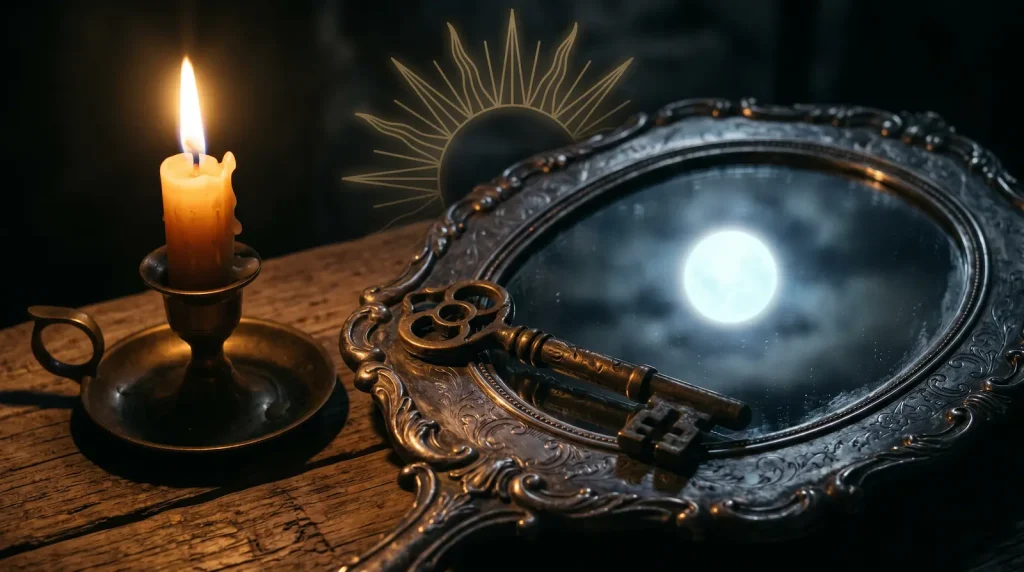
The Symbolism of the Moon, the Sun, the Mirror, the Key, and the Candle: Why These Images Are So Popular
There are images that never seem to age. You can see them in myths, religious texts, dreams, jewelry, tattoos, book covers, films, interiors, and even in everyday language. The moon, the sun, the mirror, the key, and the candle belong to that category. They are not just beautiful. They work on a deeper level: they trigger associations, awaken memory, illuminate inner states, and give people a sense of meaning.
More than decoration: why symbols affect us so deeply 🌙
Human beings do not think only through logic. We also think through images. That is why certain symbols survive centuries, languages, and cultures. Their power lies in the fact that they are both simple and layered. The same image can suggest protection, fear, mystery, hope, or transition depending on the context, emotional state, and personal experience.
The popularity of the moon, the sun, the mirror, the key, and the candle can be explained by the fact that they stand at the meeting point of the outer and the inner world. These are objects or phenomena familiar to everyone. But in culture they have long moved beyond ordinary function. They became a language for speaking about things that are difficult to explain directly: the soul, fear, change, revelation, self-discovery, and light inside darkness.
That is why these images appear so often where the goal is not just to create a picture, but to create atmosphere. They immediately suggest depth. Even when a person does not know their full symbolic history, the emotional response is often intuitive and accurate.
The moon and the sun: two poles between which people recognize themselves ☀️🌙
The symbolism of the sun and the moon is so deeply rooted in culture that it often feels almost natural. The sun is traditionally linked with clarity, strength, life, visibility, active energy, will, warmth, and outward movement. It represents what is manifest. What can be seen. What gives direction.
The moon, by contrast, is more often associated with intuition, changeability, night, rhythm, feminine energy, inner life, emotional depth, and mystery. It is not about direct light, but about reflection, silence, and states that cannot always be explained immediately.
Why are these images so popular? Because people see themselves in them. Each of us has a desire to be sun-like — to act, shine, be visible, and have strength. But we also have a need to be moon-like — to withdraw, to change, to keep some things hidden, to move through inner cycles. That duality makes both symbols vivid and personal.
In contemporary culture this is especially clear. The sun often appears in conversations about energy, vitality, success, and clarity. The moon appears where sensitivity, intuition, femininity, magnetism, and inner transformation are discussed. Together they create a fuller picture of the human being than either symbol could create alone.
The mirror and the key: why images of mystery and access attract us so strongly 🪞🗝️
The mirror is one of the strongest symbols in culture because it almost never speaks only about appearance. Symbolically, the mirror is connected with truth, self-knowledge, duality, inner reflection, the shadow side, and the fear of seeing oneself without decoration. It can be a symbol of honesty, but also of illusion.
That is why mirrors appear so often in fairy tales, mystical plots, psychological imagery, and art. Human beings have always been haunted by one question: what will I see if I look not at the mask, but deeper? The mirror seems to promise an answer. At the same time, it can be frightening, because the answer may not be comfortable.
The key works alongside this image, but differently. It is a symbol of access, solution, transition, the right to enter, and the possibility of opening what is closed. In many cultural narratives, the key is not just an object, but permission to approach truth, mystery, a new stage, or hidden knowledge.
The popularity of the key grows from a deeply human need: we want to find what opens meaning. “The key to oneself,” “the key to the heart,” “the key to the mystery,” “the key to a new life” — these expressions remain alive for a reason. They fit the psychology of a person searching for an answer, an exit, or access to something essential.
If the mirror reveals, the key allows movement forward. One image confronts. The other offers possibility.
The candle as a symbol of presence, memory, and inner light 🕯️
The candle seems simple. Yet that simplicity is part of its strength. Symbolically, it is almost always linked with light in darkness, silence, prayer, memory, concentration, emotional presence, hope, and a fragile but living flame.
Unlike the great sun, a candle is a small light a person can keep near. That is why its image carries such emotional force. The sun is majestic and distant. The candle is intimate. It enters the private space of human life: ritual, evening silence, grief, searching, prayer, or an inner conversation with oneself.
The popularity of the candle also comes from the fact that it mirrors human states so well. A candle flame is alive, yet fragile. It may tremble, fade, burn steadily, or brighten. That makes it easy to connect with emotion, faith, hope, intention, and remembrance.
In the modern world the candle has not lost its power, even though we are surrounded by electric light. On the contrary, it has become even more symbolic. People light candles not because they need light in a practical sense, but because they want to create a state: to focus, to honor, to calm themselves, to mark something important, or to give themselves a pause.
Why these images keep returning again and again ✨
The popularity of the moon, the sun, the mirror, the key, and the candle is not based only on tradition. It is also connected with their flexibility. These symbols work equally well in spiritual contexts, psychology, aesthetics, popular culture, and personal stories.
The moon can be read as intuition, femininity, or changing life phases. The sun as strength, clarity, character, or renewal. The mirror as self-knowledge, truth, or illusion. The key as access, chance, or answer. The candle as memory, hope, or inner light. None of these symbols is locked into one meaning. That is exactly what keeps them alive.
There is another reason for their lasting appeal: they create depth without requiring long explanation. A person sees a key, a mirror, or a candle and already senses that something more stands behind it. In an age of fast content, that matters even more. These images immediately communicate atmosphere, meaning, and tension.
That is why they work so well in visual culture, writing, jewelry, branding, spiritual practice, and personal symbolism. They do not simply decorate. They help people feel that inner experience can be expressed through a simple but powerful sign.
FAQ
Why are the moon and the sun used so often in symbolism?
Because they reflect a basic human duality: outer and inner life, action and contemplation, clarity and mystery, strength and sensitivity.
What does a mirror symbolize?
Most often it symbolizes self-knowledge, truth, reflection, the shadow side of personality, or the border between what is visible and what is hidden.
Why is the key considered such a powerful symbol?
Because it is connected with access, solution, transition, and the possibility of opening a new stage, new knowledge, or an inner resource.
What does the candle mean in cultural and spiritual contexts?
The candle often symbolizes light in darkness, memory, prayer, hope, inner presence, and the fragile but living flame of the soul.
Why are these symbols still so popular today?
Because they are simple, emotionally understandable, and rich in meaning. They fit modern culture easily while still carrying deep associations people feel intuitively.
The moon, the sun, the mirror, the key, and the candle remain popular not because they are fashionable mystical decorations, but because they touch permanent human themes: who am I, where am I going, what is hidden, what can be opened, where is my light, and how do I keep myself in the dark. That is why these images return again and again — in culture, language, dreams, art, and personal searching.