
What does a broken mirror mean in folk belief? Discover the origin of this omen, the cultural fear of mirrors, psychological explanations, and a modern interpretation without mystical exaggeration.
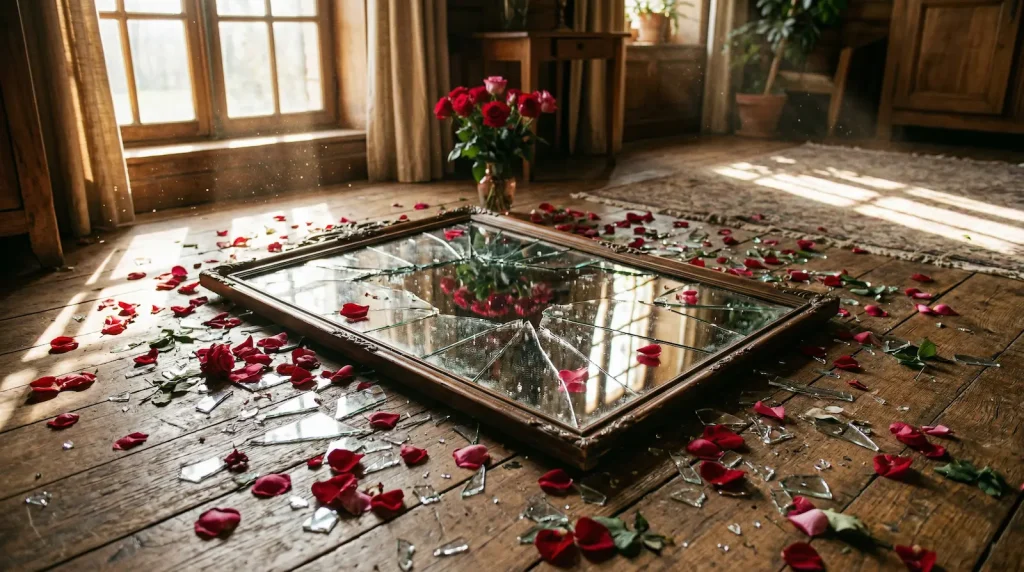
What a Broken Mirror Means: Where This Omen Came From and Why It Still Frightens People
A broken mirror scares even people who do not consider themselves superstitious. The fear often appears before the thought itself: as if something more than a household accident has happened. That instant reaction reveals something important. The omen of the broken mirror is no longer just an old folk belief — it has become part of cultural memory.
More than an object: why mirrors were long seen as special 🪞
In many cultures, a mirror was never treated as an ordinary thing. It was connected not only with appearance, but with the idea of the double, the soul, the hidden self, and the border between the visible and the invisible. That is why mirrors were approached with both fascination and caution.
In traditional beliefs, a mirror seemed to hold a trace of the person who looked into it. This makes sense within older ways of thinking: anything that shows your face every day, reflects your emotions, your aging, your changing condition, begins to feel like an object with memory. That is why mirrors appeared in divination, rituals, and rites of passage. In some homes, they were even covered after a death in the family.
This is why a broken mirror symbolized more than damaged glass. It looked like a break in wholeness itself. A person saw the fragments and felt not just inconvenience, but a disturbance in the familiar order of things.
Where the omen of bad luck came from 🔮
The best-known version of the belief says that breaking a mirror brings seven years of bad luck. This idea is usually linked to older European traditions that formed over centuries. In ancient and later folk imagination, a reflection was often seen as more than an optical effect. It was tied to a person’s essence, vitality, or even the image of the soul. If the mirror broke, then symbolically something deeper had been damaged as well.
The number seven was not random either. In many traditions it was associated with cycles, completion, purification, and transition from one state to another. That is why the phrase “seven years” became so persistent. It was not based on proof, but on symbolic logic that felt convincing within the culture.
Over time, people forgot the deeper explanations but kept the fear. That is often how durable superstitions survive: the meaning fades, but the emotional reflex remains.
Why this belief still affects people so strongly 😨
The power of this omen is not based on tradition alone. It also comes from the combination of image, sound, and suddenness. A mirror breaks sharply, loudly, with a very specific cracking sound. The fragments are dangerous. The reflection becomes distorted. All of this creates an immediate sense of alarm before the mind can evaluate the situation rationally.
There is also a deeper psychological factor. We are used to seeing ourselves as whole in a mirror. Once it is broken, that familiar image becomes fragmented. Even for a moment, this causes discomfort. It is like looking at a visual symbol of disorder. That is one reason a broken mirror feels more disturbing than a broken mug or a cracked plate.
Cultural memory adds another layer. Most people heard some version of “don’t ever break a mirror” in childhood. Even if they reject the superstition as adults, the old emotional pattern may still activate automatically. That is not proof of mystical power. It is an example of how suggestion and memory work.
What really frightens us: mysticism or loss of control 🧠
When a person is frightened by a broken mirror, they are often not reacting to the glass itself. What unsettles them is the sudden disruption. One moment everything is normal — the next there is a crack, fragments, disorder. Events like this shake our sense of control. And superstition quickly offers a ready-made explanation: “It is a sign.”
In that sense, the broken mirror omen is deeply human. It did not appear out of nowhere. People have always struggled with randomness. When something breaks suddenly, the mind wants to see meaning, warning, or pattern. That is one way the psyche tries to make the world feel less chaotic.
This works especially strongly during periods of stress, grief, uncertainty, or exhaustion. If a person is already tense, a broken mirror can become not just an incident but an emotional trigger. One person will sweep up the pieces and move on. Another may carry a heavy feeling for days.
How to view this omen today without extremes ✨
A modern perspective does not require mocking old beliefs or surrendering to them. A broken mirror can be understood as part of cultural symbolism — a point where everyday life, fear, memory, and imagery meet. It is a strong example of how an ordinary object can gather emotional weight across generations.
For some people, this omen is only superstition. For others, it may be a reason to pause, breathe, and notice their own state more carefully. That can have real value, as long as it does not become panic. Not because the mirror predicts disaster, but because unexpected events sometimes reveal how tired, anxious, or vulnerable we already are.
The calmest position is this: a broken mirror does not control fate, but it can remind us how powerfully symbols affect the human imagination. The real force lies not in the glass, but in the meaning we attach to it.
FAQ
What does a broken mirror mean in superstition?
In folk belief, a broken mirror was often seen as a sign of bad luck, broken harmony, or damaged protection. This is symbolic interpretation, not proven fact.
Where did the idea of seven years of bad luck come from?
It is usually linked to older European beliefs in which mirrors were tied to the human essence, while the number seven symbolized an important life cycle.
Why are people still afraid of a broken mirror?
Because of cultural memory, the emotional shock of the event itself, and the discomfort caused by seeing a fragmented reflection.
Is there any mystical meaning in it?
In a cultural and symbolic sense, yes — mirrors hold a special place in ritual and folklore. In a literal sense, the omen cannot be treated as a proven rule of reality.
What should you do if a mirror breaks?
First, clean up the pieces safely so no one gets hurt. After that, try not to frighten yourself further. At most, let it remind you to slow down and regain your balance.
A broken mirror frightens people not because glass secretly rules human destiny. It frightens us because it touches a very old human fear: the fear of a crack in the familiar world. That may be why this omen still lives on — not in magic itself, but in memory, imagination, and the need to find meaning even in accidental fragments.