
A deep article about the most common everyday superstitions: why people still believe in them, how they work in daily life, and what stands behind them without mystical explanations.
The Most Common Everyday Superstitions People Still Believe in Even Without Mysticism
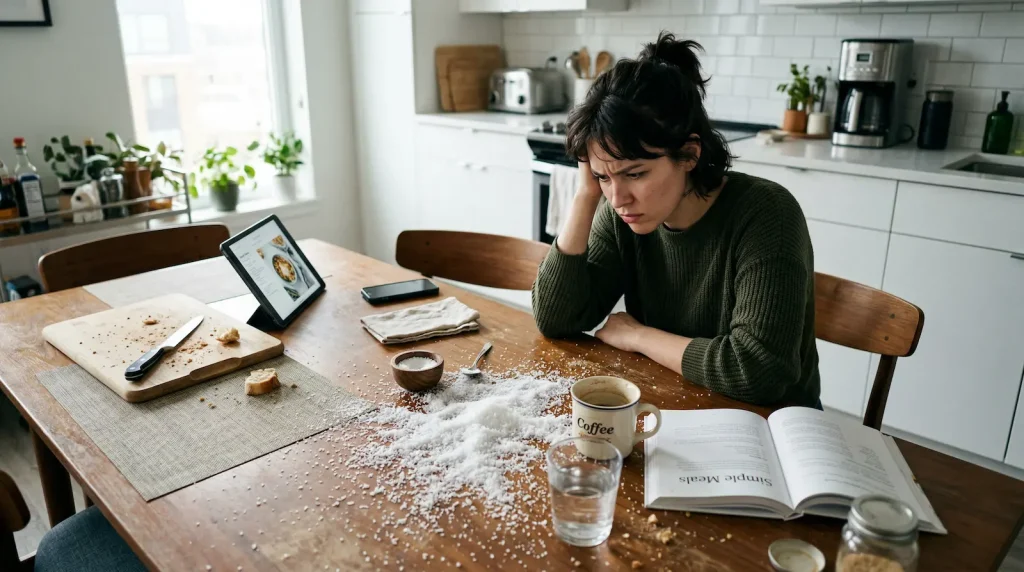
Strangely enough, many people can laugh at mysticism, ignore horoscopes, reject the idea of “signs from above” — and still instinctively avoid whistling indoors, passing things over a doorstep, or stay oddly uneasy when salt spills. Everyday superstitions survive not because everyone truly believes in the supernatural. They survive because they rest on habit, emotional memory, family patterns, and those small anxieties people do not always notice.
Superstition without magic is often a way to manage uncertainty 🏠
Most household superstitions function less like secret knowledge and more like daily psychology. People do not live easily with total uncertainty. When something feels unstable, even a small symbolic rule can restore a sense of order.
That is why simple signs stay powerful: do not take the trash out at night, do not return home once you have already left, do not leave knives lying around, do not put a bag on the floor. Even people who call themselves rational often admit the same thing: “I know it sounds silly, but I still do not want to test it.”
That is exactly where the power of everyday superstition lies. It does not require full belief. A small amount of inner tension is enough. A person may not truly think disaster will follow, but it feels easier to follow the ritual than to ignore it and later wonder whether it meant something after all.
Why thresholds, salt, and mirrors still hold such power 🪞
Some superstitions have survived for centuries even though daily life has changed. One of the strongest is the idea that nothing should be passed over a doorstep. In symbolic tradition, the doorstep was often treated as a border between one world and another, between safety and the outside. Even without mysticism, the meaning is easy to understand: anything that happens on a boundary feels less stable.
Salt has a similar story. Spilled salt still causes a quick inner reaction in many people. Part of that comes from older times when salt was valuable, and losing it meant real loss. Over time, practical irritation turned into a symbol of conflict, bad luck, or tension.
Mirrors create an even deeper effect. They belong to the ordinary world, yet they also trigger a sense of doubling and unease. That is why a cracked mirror, sleeping opposite a mirror, or discomfort around a dark reflection often says as much about human psychology as it does about superstition.
Many superstitions are encoded rules of order and safety 🧂
A large part of household superstition has entirely earthly roots. A practical rule slowly gathered emotion, fear, and symbolic meaning. Not whistling inside the home may sound mystical today if linked to losing money, but at its core it may have been about noise, irritation, or the feeling of disorder.
Do not leave sharp objects carelessly, do not sit on the table, do not step over a person, do not wash the floor immediately after someone leaves — all of these could once have helped preserve order, attentiveness, and respect. But dry rules rarely survive for generations. Rules attached to fear usually do.
In that sense, superstition is a very durable form of folk memory. It is not always logical, and not always accurate, but it survives well. People remember “do not do it or trouble will follow” far better than a neutral “that is not how it is done.”
Family memory is often stronger than rational arguments 👵
One of the main reasons everyday superstitions are still alive is simple: they come from home, not from books. A person may grow up in a modern environment, but if a grandmother always stopped someone from handing over keys across the doorstep, or a mother always picked a bag up off the floor saying “we do not do that,” the pattern settles deeply.
These habits work not only as rules, but as emotional traces of closeness. Along with the superstition, a child absorbs tone of voice, care, and a domestic feeling of safety. As an adult, that person may laugh at it — and still repeat the action automatically.
That is why many superstitions survive even among critical thinkers. Rational explanation does not always erase emotional reflex. If something was repeated in the family for years as the “right” thing to do, it begins to live in the body almost on its own.
The most common superstitions today survive through “just in case” thinking 🔑
Modern people rarely think in terms of “if I do this, punishment will definitely follow.” More often the formula sounds like this: “I am not sure it is true, but why take the risk?” That “just in case” attitude is the new form of an old superstition.
Among the most common everyday signs people still avoid are these: not whistling indoors, not passing things over a doorstep, not returning halfway without looking in a mirror first, not putting a bag on the floor, not spilling salt, not taking out the trash at night, not giving a clock or knives without a symbolic coin, not celebrating in advance, and not staring too long into a cracked mirror.
These may look like tiny details. Yet such details reveal how people organize their inner everyday life. Even without mystical thinking, they often keep small rituals that create a feeling of order, predictability, and protection from chaos.
FAQ
Why do people still believe in everyday superstitions?
Because they do not survive only through belief in the mystical. They also survive through habit, family upbringing, emotional memory, and the human need to reduce uncertainty.
Do all household superstitions come from mysticism?
No. Many of them likely began as practical rules related to safety, order, economy, or social behavior and only later acquired symbolic meanings.
Why do rational people still follow superstitions sometimes?
Because rational thinking does not erase automatic habits. If a rule has been emotionally reinforced since childhood, a person may repeat it even without literal belief.
Which everyday superstitions are the most common?
Some of the best known include not whistling indoors, not passing items across a doorstep, not spilling salt, not putting a bag on the floor, not taking out trash at night, not celebrating early, and not giving sharp objects without a symbolic payment.
Should people completely reject superstitions?
That depends on the person. If a superstition does not create fear, control behavior too strongly, or interfere with clear thinking, it can remain a cultural habit. The problem begins when a small sign becomes constant anxiety.
Everyday superstitions survive not because people have all returned to mysticism. They survive because they are deeply rooted in ordinary life — in kitchens, doorways, roads, gestures, and inherited phrases. As long as people need small rituals against big uncertainty, such beliefs will remain.