
What do the male archetypes of the Magician, the Emperor, and the Hermit mean in Tarot? A deep article about power, control, wisdom, the inner path, and the psychological meaning of these images.
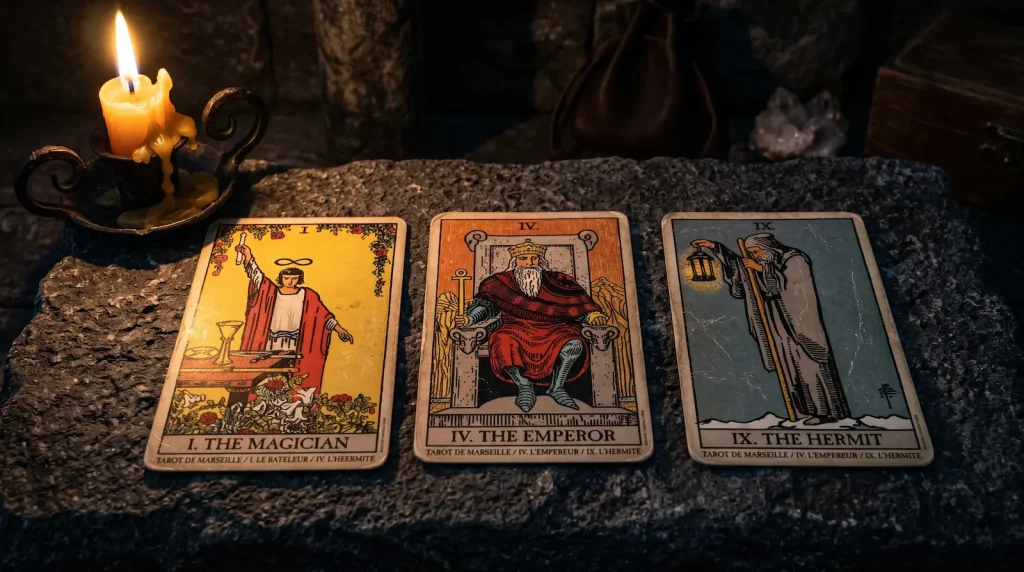
The Magician, The Emperor, The Hermit: What Male Archetypes Say in Tarot Cards
There are men who enter a space and immediately change it. Not because they speak louder than others, but because they carry different forms of power: one initiates, one stabilizes, one steps back in order to see the truth. In the symbolic language of Tarot, the Magician, the Emperor, and the Hermit are not just figures from a deck. They are three highly recognizable models of masculine presence that can be seen in character, relationships, crises, and the way a person lives through power.
The Magician: the man who sets reality in motion ✨
In Tarot, the Magician is not a “wizard” in the literal sense, but the archetype of a person who can turn intention into action. In a masculine dimension, this is the image of someone who does not wait for the perfect moment but begins with what he already has. He speaks, proposes, experiments, persuades, and creates the first movement. That is why the Magician is often associated with charisma, intelligence, willpower, and the ability to influence through words.
In real life, this archetype appears in very concrete ways. It may be the man who can inspire with an idea, quickly find a solution, and gather people around a vision. He feels the power of beginning. Around him, there is often a sense that anything is possible if the goal is named clearly and the available resources are focused.
Yet this image also has a shadow. If the Magician becomes detached from ethics and inner honesty, his power turns into manipulation. Then he no longer creates; he plays on other people’s weaknesses. He does not lead; he enchants for the sake of control. That is why this card often reminds us that real power is not in making an impression, but in taking responsibility for the consequences of one’s influence.
The Emperor: order, boundaries, and the weight of decisions 👑
If the Magician starts the process, the Emperor secures it. This is the archetype of structure, stability, authority, boundaries, and responsibility. Symbolically, it speaks of a type of masculine energy that does not seduce with possibility but builds a form strong enough to endure time.
In real life, the Emperor is recognized not by loud words but by inner composure. This is the man who does not fall apart in a critical moment. He can make decisions, withstand pressure, and hold the frame when others lose their footing. His strength lies not in effect, but in steadiness. Such people often become the ones others rely on in family life, business, conflict, or times of instability.
But the Emperor also has a dangerous side. When control becomes more important than living reality, it hardens into rigidity. When authority becomes separated from wisdom, coldness appears, along with the need to dominate and the inability to hear weakness, both in himself and in others. In that state, the man no longer protects the space; he suppresses it. That is why this card is not only about the force of authority but about maturity in the use of power.
The Hermit: not weakness, but depth 🔥
Compared with the Magician and the Emperor, the Hermit may seem like the least “masculine” image in a stereotypical sense. He does not display power, conquer space, or prove status. But that is exactly where his meaning lies. In Tarot, the Hermit is the archetype of inner maturity, distance, the search for truth, voluntary silence, and a depth that does not need outer noise.
In masculine psychology, this is an extremely important image because it contradicts the primitive idea that a man must always be active, hard, and visible. The Hermit reveals another kind of strength: the ability not to react instantly, not to rush, not to prove one’s importance every minute. This is the man who can be alone with himself, endure a pause, and move through crisis without turning it into theater.
In life, this archetype often appears in men who observe a lot, promise little, open up slowly, but see deeper than the surface. They are not always convenient in a fast world, but they often prove the most accurate in complex human matters. Their shadow is isolation, cold detachment, and the escape from intimacy under the guise of “finding oneself.” Yet in its mature form, the Hermit is the rare ability not to lose one’s soul in the noise of roles and expectations.
Three archetypes, three ways of being a man 🧭
The most interesting part of these cards is that they do not contradict one another. They show different levels of masculine maturity and different mechanisms of interacting with the world. The Magician says, “I can begin.” The Emperor says, “I can hold.” The Hermit adds, “I can understand why all this matters.”
In life, it is rare for a person to correspond fully to only one archetype. More often, we see a combination. A man may be a strong Magician in his work, an Emperor in crisis, and a Hermit in his inner search. Or, on the contrary, behind the image of a rigid Emperor there may be a person who is afraid to remain alone with himself and therefore avoids the Hermit within.
These cards are valuable because they allow us to see not the mask, but the mechanism. Not only “what he is like,” but how exactly he lives through power, control, action, solitude, responsibility, and silence. That is why male archetypes in Tarot are often read not as a simple personality sketch, but as a map of inner conflict or development.
What this means for relationships and daily life 💬
In relationships, the Magician often appears as the initiator. He knows how to attract, ignite, and create a sense of movement. But if there is no depth behind it, a powerful beginning may leave emptiness afterward. The Emperor gives a sense of safety, reliability, and clear boundaries. With him, life may feel stable, but if he loses contact with emotion, the relationship becomes cold. The Hermit brings honesty, silence, depth, and the ability not to play roles. Yet in an immature form, he may withdraw precisely when presence is needed most.
In everyday life, these archetypes are also easy to recognize. One man solves everything through action and speech. Another through control, system, and structure. A third through distance, observation, and inner analysis. None of these ways is “correct” in itself. What matters is not the form, but the level of maturity with which it is lived.
Symbolically, Tarot does not attach a label. It invites us to look deeper: where power becomes pressure, where silence turns into wisdom, and where it becomes escape, where initiative is creativity, and where it is merely a way to hold attention. That is why these archetypes remain relevant: they explain not mysticism for its own sake, but very human and very earthly mechanisms.
FAQ
What does the Magician symbolize in a male archetype?
The Magician symbolizes initiative, will, charisma, verbal power, and the ability to set events in motion. In a mature form, he is a creator and guide; in a shadow form, a manipulator.
What does the Emperor mean in Tarot?
The Emperor is linked with order, authority, responsibility, boundaries, and structure. He represents the man who holds a system together, makes decisions, and creates stability.
What does the Hermit archetype speak about?
The Hermit speaks about inner maturity, self-knowledge, distance, wisdom, and the need to seek truth without unnecessary noise. It is not weakness, but another form of strength.
Can these archetypes exist together in one person?
Yes, and that is usually the case. In different areas of life, a person may embody different archetypes: an initiator in one place, a source of stability in another, and a reflective seeker in another.
Does Tarot literally describe a man?
No. In this context, Tarot should be read as a symbolic, psychological, and cultural language of images. The cards do not prove facts; they offer a way to interpret character, behavior, and inner patterns.
What is most powerful about these three cards is that they show masculine strength is not limited to one kind of behavior. It can be sharp like the Magician, solid like the Emperor, or quiet like the Hermit. And that difference is exactly what makes Tarot archetypes not decorative symbols, but a precise tool for reading human nature more deeply.