
Why do people still believe in household superstitions? A deep article about the most common omens, their psychological meaning, cultural roots, and role in daily life.
The Most Common Household Superstitions People Still Believe In
There are people who laugh at omens but still instinctively avoid handing things across the doorstep, whistling indoors, or ignoring spilled salt. That contradiction is the most interesting part. Household superstitions survive not because everyone literally believes them, but because they are built into daily gestures, family habits, and that quiet feeling of, “What if it matters?”
Small actions that hold big anxiety 🏠
The most common household superstitions always revolve around ordinary things: doors, mirrors, money, tables, dishes, brooms, salt, bread. That is not accidental. Everyday domestic life is where people want stability the most. When something goes wrong at home, even a small incident can trigger a stronger emotional response than a larger problem outside it.
That is why omens often appeared as a way to explain and control everyday uncertainty. A broken dish might mean a quarrel — or, in another tradition, good luck. Spilled salt might mean tension is already in the air. Whistling in the house might “drive money away.” Behind these beliefs is an old human need: the hope that chaos can be interpreted and, at least a little, managed.
Many people today no longer take such things literally. But the psychological mechanism remains. When life feels unstable, even a rational person starts paying more attention to small signs.
Why people do not hand things across the doorstep 🚪
One of the most persistent household superstitions is the rule against passing objects across the doorstep or greeting someone while standing on opposite sides of it. In traditional thinking, the doorstep was never just part of the house. It was a boundary — between inside and outside, safety and uncertainty, one world and another.
Even in modern life this omen survives among people who would never call themselves mystical. Someone may say, “Come in, or I’ll step out — but I won’t hand it to you across the threshold.” That is not always about belief in spirits or unseen forces. Often it is about discomfort when an invisible order feels broken. People feel calmer when contact happens “properly,” without hovering between spaces.
That is how many superstitions work. They hold their power not through magic, but through ritual. Ritual calms the mind. It creates a frame where life otherwise feels messy.
Salt, mirrors, and whistling: signs that outlived generations 🪞
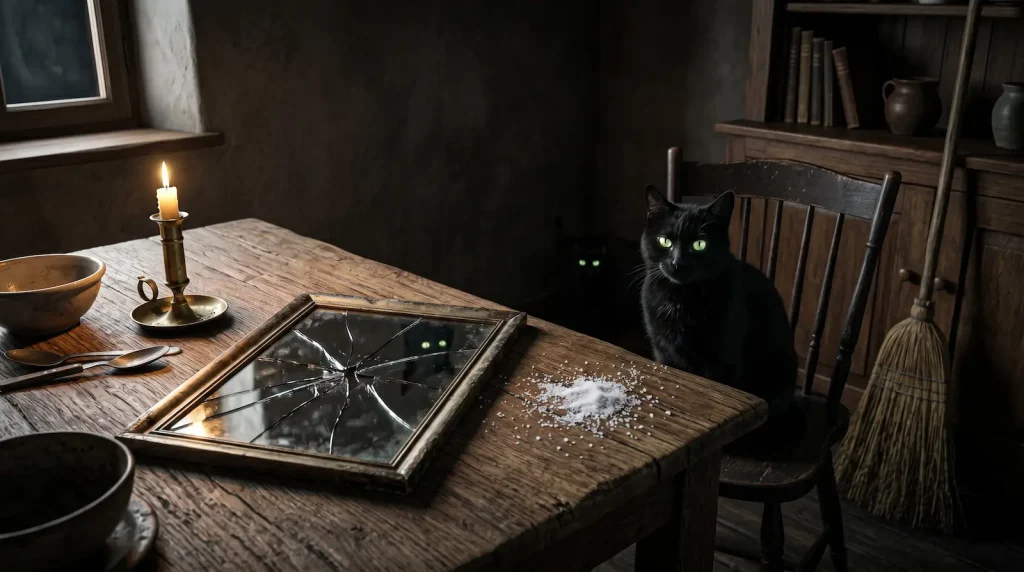
Among the most familiar household superstitions, a few have survived for centuries. Spill salt — expect a quarrel. Break a mirror — expect misfortune. Whistle indoors — invite poverty. Sit on a table — bring trouble. Leave a knife blade-up — create danger. Take out the trash at night — risk losing good fortune. These ideas differ on the surface, but they share the same inner logic: the home is treated as a place of order, protection, and prosperity that can be disturbed by careless actions.
The mirror is especially revealing. For centuries, it was seen not only as an object, but as a symbol of reflection, truth, fragility, and threshold. That is why a broken mirror often provokes a reaction far stronger than the event itself seems to deserve. It is not just broken glass. It is the image of a crack in the familiar world.
Salt was precious in many cultures, so wasting it already felt significant. Over time, that material value turned into emotional symbolism. Whistling indoors could be associated with carelessness, disorder, even disrespect for the home. In other words, many omens have very earthly roots: resource value, discipline, order, and respect.
Superstitions about money, guests, and domestic order 💸
A separate group of omens is connected with prosperity. Empty bottles should not stay on the table. Money should not be handed over in the evening. Crumbs should not be swept off the table with the bare hand. Salt or bread should not be lent at certain times. Trash should not be taken out at night so as not to “carry luck out of the house.” In these beliefs, the collective fear of instability becomes especially visible.
In folk culture, money was never just money. It meant food, survival, dignity, and the ability not to depend on someone else’s mercy. That is why anything linked symbolically with emptiness, waste, leakage, or carelessness gradually gathered omens around it.
What is striking is that these ideas are often passed on today not through firm conviction, but through tone. “Don’t do that.” “We don’t do it this way.” “Grandmother always said so.” That alone is enough for a person to feel that a small act carries more weight than it seems. This is how a superstition becomes part of household culture.
Why even skeptics sometimes follow omens 🧠
The clearest explanation is simple: superstitions are convenient for the mind. They offer the illusion of predictability. If the world cannot be fully controlled, at least one can avoid whistling indoors, passing things across the threshold, or ignore spilled salt by throwing a pinch over the shoulder.
They also work as family memory. Household omens carry not only fear, but style, atmosphere, and continuity. In them you can still hear older voices, smell an old kitchen, and sense an older way of treating space, food, and objects with care. Even someone who claims not to believe may still follow a superstition because it keeps them connected to something familiar and inherited.
That is why mocking these traditions is too easy. It is more interesting to see them as part of a cultural language of everyday life — a language people once used to make life a little safer, clearer, and more ordered.
When an omen stops being tradition and becomes tension 🌙
There is, however, an important boundary. There is a difference between not greeting someone across the threshold because that is how your family does things, and feeling anxious over every “wrong” movement. When a superstition stops being a small cultural habit and starts ruling mood, choices, and daily peace, it no longer says much about mysticism. It says more about anxiety.
In a healthy form, household superstitions survive as tradition, symbolic play, or domestic ritual. In an unhealthy form, they become a constant expectation of trouble. That is the moment when perspective matters most: omens can tell us a great deal about culture, but they should not take away freedom of thought.
FAQ
Why do people still believe in household superstitions?
Because they are tied not only to belief, but also to emotion, habit, family culture, and the need for control. Even without literal faith, they can create a sense of order.
Which household superstitions are the most common?
The most common include not passing things across the doorstep, spilled salt, broken mirrors, whistling indoors, taking out the trash at night, and various money-related omens.
Do superstitions have any real basis?
In many cases, yes — but usually cultural or practical rather than mystical. Some began as rules of caution, thrift, etiquette, or symbolic thinking.
Why do these omens feel stronger at home?
Because home is associated with safety, control, and stability. People are especially sensitive to anything that seems to threaten domestic order.
Is it normal to follow omens even if you are not superstitious?
Yes, as long as it does not become fear-driven or harmful to daily life. For many people, it is simply part of habit, family code, or cultural memory.
Household superstitions have survived for centuries not because people stopped thinking rationally. They endure because they touch something subtle and human: fear of loss, longing for order, memory of home, and the need to find meaning in the small things life is made of.