
What does it symbolically mean to find a coin near your home, on the doorstep, or in the pocket of old clothes? A deep article on folk signs, psychological meaning, and possible interpretations.
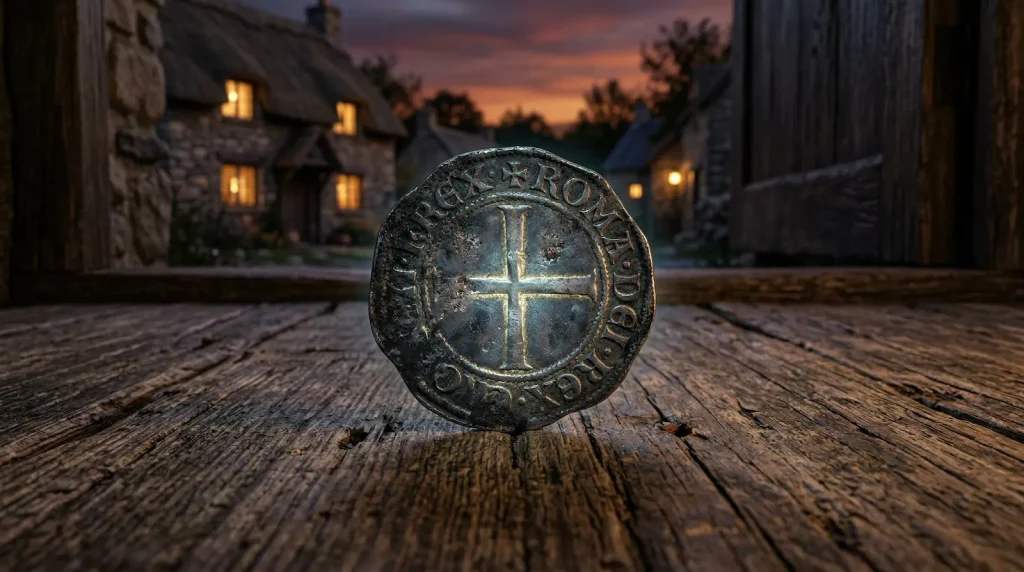
What It Means to Find a Coin Near Your Home, on the Doorstep, or in the Pocket of Old Clothes
Sometimes a person can walk past a small coin dozens of times without noticing it at all. And sometimes one случайная находка clings to the mind much more strongly than it should. Especially if the coin is lying near the house, on the doorstep, or suddenly appears in the pocket of an old coat that no one has worn for years. In such moments, many people look not for material value, but for a sign: why now, why here, and what it may mean.
✨
A Coin as a Sign Not of Money, but of Exchange
In folk belief, a coin was almost never just a piece of metal. It was associated with the movement of prosperity, with giving and receiving, with the return of a debt, with a blessing for the road, or, on the contrary, with a warning about an unhealthy exchange with life. That is why a found coin was often read symbolically rather than literally.
In household superstition and traditional signs, a coin means more than income. It can point to the energy of value: what a person gives, what they accept, how they treat their own resources, whether they are able to notice small gifts. This is an important nuance, because not every such find promises money. Sometimes it is more of a reminder: there is something in your life that has been undervalued, lost, or forgotten, but not completely gone.
That is why the meaning depends not only on the coin itself, but also on the place where it was found. Near the home, on the doorstep, or in old clothes, the meaning changes, because each of these spaces has its own symbolism.
🏡
Near the House: A Sign Touching Safety, Energy, and Personal Boundaries
When a coin is found near the house, it is often interpreted as touching the theme of the home field. In traditional thinking, home is not just walls, but a space of protection, family, habit, and everyday stability. What appears near the home seems to enter the circle of personal life.
One of the most common interpretations is a sign of a small but real gain or improvement that begins not with a grand event, but with a subtle shift. For example, a side job may appear, an old debt may return, or a household problem that has long been hanging over a person may finally be resolved. Not because the coin “creates magic,” but because in cultural symbolism it means the movement of resources into your space.
But there is another reading too. A coin near the home may ask a quiet question: do you value what you already have? Very often people wait for a major breakthrough and fail to notice how they neglect what supports them little by little every day. In that sense, a coin near the house is not about a miracle, but about attention. About the ability to see that abundance sometimes begins not with a large amount, but with the return of a sense of inner support.
🚪
On the Doorstep: A Sign of Transition, Choice, and Another Person’s Trace
The doorstep has a special place in folk symbolism. It is the boundary between inside and outside, between what is one’s own and what belongs to others, between what is protected and what is exposed. That is why any object found on the doorstep creates more tension than the same object in the yard or on the road.
A coin on the doorstep is seen in some traditions as a good sign of a coming message, guest, opportunity, or beneficial offer. It seems to say: something is already standing at the entrance to your life. But in other interpretations, people are more cautious, because the doorstep is also linked with the transfer of another person’s intention. That is why many people instinctively do not want to pick up something found by the door with bare hands.
There is no need to fall into fear. The very fact of finding a coin on the doorstep does not automatically mean anything bad. But symbolically, such a find often concerns the theme of choice: what you allow into your home, which offers you trust, what truly brings benefit, and what only disguises itself as gain. If the coin is lying directly on the threshold, it may be a sign to pay closer attention to boundaries, both material and emotional.
Sometimes such a sign coincides surprisingly well with periods when a person stands between two decisions: whether to remain in the old, accept a new job, open the door to someone a second time, or give a chance to something that once caused doubt. In that sense, the doorstep speaks not about money, but about the moment of crossing over.
🧥
In the Pocket of Old Clothes: The Return of Something That Was Once Yours
This is perhaps the most interesting version of the sign. A coin in the pocket of old clothes is almost always felt differently from a random coin on the street. There is no sense of strangeness here. On the contrary, there is often a strange feeling that the past itself has reached out a hand to you.
Symbolically, this is often connected with the return of forgotten resources. Not necessarily financial ones. It may be an old idea, a skill, a bond, a character trait, or a courage that a person lost after some blow in life. Old clothes work here as a container of memory: they preserve a period of life in which you were different, and suddenly they return something small, but meaningful.
Such a find often appears in moments of inner stagnation. A person is sorting through belongings, putting things in order, preparing to let something go, and at that very moment finds a coin. This can be read as a soft sign: not everything from the past needs to be thrown away. Sometimes something alive is hidden among the old, something that can still work for you.
Psychologically, this is also very understandable. A small object found in a long-forgotten pocket awakens memory and gathers scattered parts of experience. That is why such a coin often evokes not so much joy as a quiet, dense sense of meaning.
🔍
Why Such Finds Feel So Charged: Not Mysticism, but Attention to the Moment
Even if we look at the situation without belief in signs, the mechanism itself is very human. We do not pay attention to what means nothing to us. If a coin suddenly catches you, then it has touched a living point: lack, anxiety about the future, the need for support, expectation of change, or doubt about an important decision.
That is why such finds often work like a mirror of one’s condition. For one person, a coin near the house may bring a sense of hope. For another, caution. For a third, a warm memory. And all three reactions will be true, because a symbol does not live on its own, but in contact with the person who noticed it.
That is why the most useful question here is not “what does this guarantee?” but “what part of my life did this respond to right now?” If a person finds a coin and immediately thinks about instability, then safety is the central theme at the moment. If they think about chance, then the need for a new stage is active. If they think about the past, then something unfinished still asks for attention.
FAQ
Does a found coin always mean money?
No. In symbolic and folk interpretation, a coin often means not direct profit, but the theme of value, exchange, the return of a resource, or attentiveness to small opportunities.
Should a coin found on the doorstep be picked up?
That depends on personal attitude. If a person feels anxious about signs, it is better not to do it impulsively. In folk tradition, objects on the threshold were treated carefully precisely because of the symbolism of the boundary.
If a coin is found in old clothes, is it a good sign?
Most often this is interpreted softly and positively: as a sign of the return of a forgotten resource, chance, or inner strength that once already belonged to your life.
Do the denomination and condition of the coin matter?
In household beliefs, people sometimes pay attention to this, but the place of the find and the person’s feeling in that moment are usually more important. Context gives the greatest meaning.
How should such signs be understood?
The best way is without extremes. Do not turn them into verdicts and do not give them magical omnipotence. It is more useful to treat them as symbolic prompts that help you look at your life more attentively.
A coin found unexpectedly almost never weighs much. But sometimes it lands exactly in the part of life where a person has long been searching not for money, but for confirmation: something can still return, shift, or open. That is why such small things are often remembered more strongly than large but empty events.