
A guide to the last digit of your birth year in numerology: what the numbers from 0 to 9 symbolize, how they are interpreted in tradition, and why this should be seen as a symbolic system rather than a proven fact.
What the Last Digit of Your Birth Year Means in Numerology
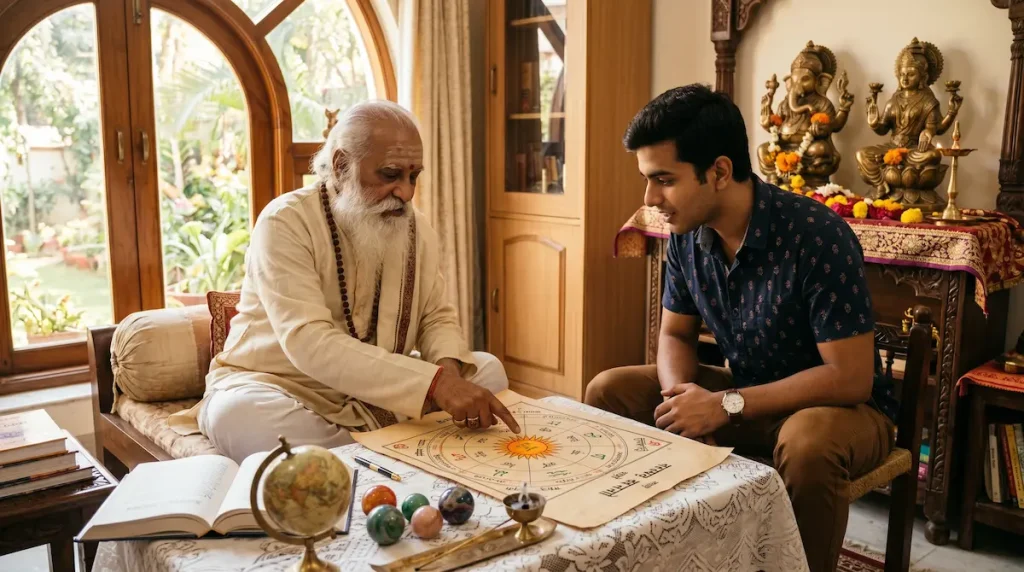
Many people think the last digit of their birth year is just a small detail. But in numerological tradition, it is often precisely such “small details” that are treated as symbolic keys to character, life rhythm, and a person’s inner way of responding to the world. It is important to separate one thing from another right away: numerology is not a science and not a proven method of describing personality, but rather a cultural and esoteric system of interpretation, historically connected with the Pythagorean idea that numbers carry special meaning.
Different schools interpret numbers differently. So what follows is not “the truth about a person,” but a popular symbolic reading of the last digit of the birth year, from 0 to 9, adapted for the modern reader. The first ten numbers hold special weight in numerological tradition dating back to antiquity, and Pythagorean thought did indeed assign distinct qualities and meanings to numbers.
0 — potential, emptiness, beginning
In modern popular numerology, zero is often associated not with “nothing,” but with pure potential: a space in which no final form has yet been fixed, but where the possibility of a new beginning already exists. Its symbolism is not about a finished character, but about openness to reset, change of direction, and a life that may begin again more than once.
Seen symbolically, people whose birth year ends in 0 may strongly feel those moments when the old has already expired, while the new has not yet fully taken shape. They often know the feeling of transition: as if life never stays in one place, but constantly prepares a new cycle. Their strength lies in the ability not to cling to an old form just because it is familiar.
1 — will, individuality, inner center
In Pythagorean tradition, 1 symbolized unity and the original source from which everything else emerges. Because of that, numerological systems often associate one with independence, inner backbone, the desire to act in one’s own way, and the refusal to dissolve into someone else’s will.
In everyday life, this can show itself as an early need to have one’s own opinion, difficulty tolerating pressure, and a natural desire to define one’s own direction. The weak side of this number is the risk of becoming trapped in one’s own certainty. The strong side is the ability to begin when others are still hesitating.
2 — sensitivity, partnership, receptivity
For the Pythagoreans, 2 had a distinct symbolic role and was connected with duality and the feminine principle. In modern numerological readings, two is usually interpreted as the number of connection, emotional response, diplomacy, and a subtle ability to read atmosphere.
People who associate themselves with this number are often not the loudest in the room, but they are frequently the first to notice tension, falseness, or a shift in mood. Their mission is not to dominate, but to connect, soften, and sense nuances. The downside is that they may become too dependent on the emotional climate around them.
3 — expression, energy, vivid presence
In Pythagorean symbolism, 3 was associated with active, creative, and expressive force. That is why in popular numerology three is often read as the number of self-expression, speech, artistry, charisma, and the ability to transmit mood to others.
If the last digit of the birth year is 3, this is often symbolically interpreted as a need not merely to live, but to express oneself: through words, style, ideas, humor, or tone. Such people may quickly inspire others, but they can also become tired of routines where there is no creative space.
4 — structure, foundation, reality
In Pythagorean tradition, 4 was linked with order, justice, and the organized structure of the world. Broader symbolic traditions also connect four with the four elements, the seasons, and the cardinal directions. That is why four is often seen as the number of foundation, discipline, and inner construction.
In personality, this can appear as the ability to hold form where others fall apart. Such people often dislike chaos, want to understand what they stand on, and trust what can be tested in practice. Their strength is reliability. Their challenge is not to turn order into rigidity.
5 — movement, experience, changing rhythm
In the Pythagorean system, 5 held a special place as a number of combination and the human dimension; it was associated, for example, with the sum of 2 and 3. In modern esoteric interpretations, five is often treated as a symbol of dynamism, change, the search for new experience, and moving beyond the familiar.
Practically speaking, this is the number of people who struggle to live within a frozen scheme. They often learn not through theory, but through personal experience, testing, mistakes, risk, and contact with new environments. On the positive side, this gives flexibility and aliveness. On the negative side, it can lead to restlessness and exhaustion from their own need for movement.
6 — responsibility, care, the ability to hold others
In popular numerology, 6 is often associated with strength, responsibility, safety, and duty. Some modern overview sources directly describe this number as linked with protection and responsibility.
At the level of character, this is often read as an inner tendency to be a support system: for family, partner, children, friends, or team. Such people often take on more than they promised and carry others for a long time, even when they themselves are struggling. Their lesson is not to confuse love with constant self-sacrifice.
7 — intuition, observation, search for depth
Seven holds a special place in many cultural and religious traditions, and number symbolism across cultures has long been rich with layered associations. In modern numerological descriptions, 7 is often linked with intuition, wisdom, inward observation, and a tendency to search for hidden meaning.
In life, this may appear as a love of silence, a need to think everything through, and an interest in psychology, spiritual topics, and meanings “between the lines.” People with this number are often slow to reveal themselves fully. They may not always be socially easy, but they are often deeply perceptive.
8 — scale, influence, material strength
In modern esoteric sources, 8 is associated with power, transmission, continuity, and even the symbol of infinity when turned on its side. That is why popular numerology often reads eight as the number of ambition, major resources, management, and the ability to work with the material world.
Such people often think in terms of results, influence, systems, and scale. They want not only to dream, but to build; not only to feel, but to achieve. Their strength lies in the ability to see how an idea becomes a structure. Their risk is beginning to measure life’s worth only through success and control.
9 — completion, maturity, inner expansion
In popular numerological interpretations, 9 is often described as the number of completion, growth, and transition to another level. Some modern sources directly connect nine with change, growth, and the ending of a cycle.
At the symbolic level, this is the number of people who often live through major conclusions, deep emotional phases, and the sense that every experience must teach something. They may carry a strong feeling of humanity, compassion, or inner mission. Their strength lies in mature vision. Their difficulty lies in the tendency to carry too much of other people’s pain.
Can a person really be defined by just one digit?
No, not literally. Even within numerology itself, the last digit of the birth year is usually not treated as the only key to personality. More often, it is one symbolic marker among others, alongside the full birth date, the life path number, or the numerical analysis of a name.
So it is best to treat these meanings not as a verdict and not as a “diagnosis,” but as a way of thinking about your own traits from a different angle. Sometimes symbolic systems are useful not because they prove something, but because they help a person formulate inner feelings more precisely.
In short: the meanings of digits from 0 to 9
0 — potential and a new cycle
1 — will and independence
2 — sensitivity and partnership
3 — self-expression and vivid energy
4 — structure and reliability
5 — change and experience
6 — care and responsibility
7 — intuition and depth
8 — influence and material strength
9 — completion and inner maturity
The most interesting thing about numerology is not that it “knows everything” about a person, but that it offers a language of symbols. And whether you recognize yourself in that language will always matter more than the digit itself.
Sources referenced in the article:
— Encyclopaedia Britannica: Numerology
— Encyclopaedia Britannica: Number symbolism
— Encyclopedia.com: Numbers: An Overview
— Learn Religions: Numerology Basics